
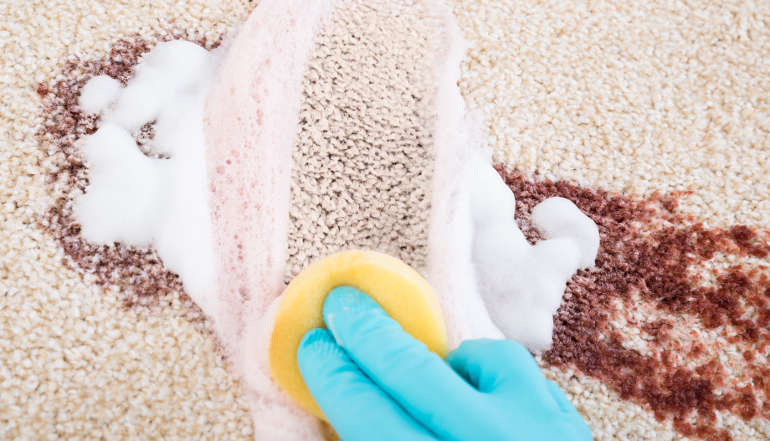
Cleaning carpet stains promptly and correctly is the difference between a stain that lifts cleanly and one that sets permanently into the fibres. This guide covers the most common stain types, including coffee, mud, tar, oil, paint, red wine, and pet urine, along with a section on old or set-in stains and what to look for in a carpet stain remover. Every method here is doable at home with basic supplies.
 Add to Preferred Sources
TL;DR
- Blot, never rub, any fresh stain immediately to stop it spreading deeper into carpet fibres.
- Coffee and red wine stains respond to a mix of dish soap, white vinegar, and cool water applied promptly.
- Mud stains should be left to dry fully before vacuuming, then treated with a mild detergent solution.
- Oil stains need an absorbent powder like cornstarch applied first, before any liquid cleaner is used.
- Old or set-in stains should be re-wetted with warm water to loosen them before applying any carpet stain remover.
Table of Contents
How to get coffee stains out of carpet
Depending on the colour of your carpet, coffee stains can be very difficult to remove. The key is to act fast and treat the stain as quickly as possible. The longer the coffee is able to soak in, the harder it will be to get rid of. Follow this step-by-step guide in order to remove the coffee stain for good:
How to remove a coffee stain from carpet using dish soap, white vinegar, and water.
Blot the stain
Blot the area with a clean cloth or napkin. Do not rub.
Loosen old stains
If the coffee stain is old, wet it with warm water first to loosen it before blotting.
Mix the cleaning solution
Mix dish soap and white vinegar with two cups of water.
Work the solution in
Using a toothbrush, sponge, or microfiber cloth, rub the mixture into the stain and blot with a clean cloth. Repeat this process until the stain is gone.
Rinse
Wet a clean cloth with cold water and remove any residue.
Dry
Let the area air dry or use your blow dryer to speed the process up.
How to get mud out of carpet

Remember to be extra careful when removing mud stains from a thin carpet:
- Remove the excess mud using paper towels. This may involve blotting up a spilt liquid or picking up solid wastes. Don’t rub, just blot in order to prevent pushing the dirt stain deeper into the carpet fibres.
- Wait until the mud has dried completely before doing anything else. Wet mud smears and embeds deeper into the fibres if you try to treat it too soon; dried mud can be vacuumed out cleanly. Once dry, vacuum the stained area in all directions to remove the dirt residue. The best way to do this is by using the hose attachment of your vacuum cleaner.
- Make a solution of a cup of water and a few drops of mild dish-washing detergent. Check our blog post for more end of tenancy cleaning tips.
- Wet a clean cloth with the mixture and then gently blot the stain. Switch to a clean part of the cloth when the previous gets dirty. Do not apply too much pressure to avoid making a hole in your thin carpet (yes, it can happen). Keep blotting the mud stain until it’s removed. If you don’t have any luck with carpet cleaning so far – proceed to the next step.
- Apply a commercial stain remover. Repeatedly dab at the stained area with a clean cloth until the stain is gone.
- Remove the cleaning solution with a clean, dry cloth. Then, use paper towels and water to rinse the area. Make sure there isn’t any soap or solution residue left.
- Let the area dry completely and avoid walking over it.
How to remove tar from carpet
A carpet tar stain is no small business, but before you book cleaning services, you can always try a few inexpensive techniques that may help you when wondering how to remove tar from a carpet.
Cleaning tar from carpet with household cleaners
- Blot the stain immediately using an absorbent towel. Make sure to remove as much of the tar as possible.
- Hold an ice cube against the affected area for at least a minute to freeze the tar. Once the tar has fully hardened, take a dull knife and scrape it off the carpet.
- Apply a solution made of equal parts warm water and liquid dishwashing detergent directly to the tar stain. Blot the area using a clean cloth, working in small dabbing motions to lift the stain.
- Once the tar stain has been removed, use a dampened cloth to blot the area of carpet you were working on to completely remove any traces of cleaner.
Removing tar from carpet using commercial products
- Find a home dry cleaning kit from your local supermarket. Make sure it uses a non-flammable dry cleaning fluid.
- Dab a cotton ball soaked in the fluid on the tar stain. We’re talking about drops of course, not flooding spills.
- Replace the dirty cotton balls with clean ones to prevent reapplying tar to the carpet.
- Keep dabbing at the problematic area until the tar is removed.
- If this tar removal method doesn’t work, use a solvent-based cleaner and follow the directions on the product’s label.
- Apply firm pressure when dabbing with the cleaner to lift the tar from the carpet.
- If that doesn’t work either, try a heavy-duty liquid disinfectant that breaks down grease and stains.
- If the stain is still visible, purchase a bug and tar remover designed for cars.
How to get oil out of carpet

To handle the situation, here are some tips for removing oil stains, presented to you by professional carpet cleaners.
How to remove oil stains from carpet using cornstarch
- Don’t let the oil stain soak in the carpet. Act immediately.
- Use an absorbent dry cloth and blot the oil stain. Don’t rub and press too hard, otherwise the oil will get even deeper into the fabric.
- Sprinkle a large amount of powdered cornstarch onto the affected area. It will absorb the remaining oil.
- After it does, remove the cornstarch with a vacuum cleaner.
- Examine the spot and check if there is any remaining residue left.
- Wash the stained area with water and some dish-washing detergent.
Cleaning oil stains from carpet with dry cleaning solvent
- Apply the dry cleaning solvent to the stained area using a clean cloth. Press strong enough to penetrate the solvent deeper into the carpet fibres and let the solution sit for at least 5 minutes.
- Blot up the solvent from carpeting using a damp cloth. Allow the area to air dry. Use a fan or a dehumidifier in order to speed the drying process.
- Once the area is completely dry, examine the carpet for any traces of the oil stain. If the stain remains, repeat the cleaning process above.
How to remove paint or ink stains from carpet
It’s important to act quickly, like with every other carpet stain, because it will be nearly impossible to get paint out of carpet when it’s dry.
Cleaning paint or Ink stains from carpet with homemade solutions
- Moisten the stained area with some rubbing alcohol. Blot the ink stain using a clean cloth. Do not rub the area to prevent spreading the stain!
- Re-wet the cloth with more alcohol and dab it over the affected area several times. Be patient! The alcohol should sit on the spot for about 30 minutes.
- Rinse the area with a solution made of a quarter cup of white vinegar and a quart of warm water.
- Once the stain is gone, rinse with clean water and let the carpet dry.
- Vacuum the area thoroughly.
Removing paint or ink carpet stains with commercial products
- Use an absorbent material, like a sponge or towel to soak up paint or ink immediately before it dries.
- Make sure no more paint or ink is transferred onto the absorbent material before proceeding with the next step. A tamping brush can be very useful when blotting up the stain too.
- Pour a small amount of carpet stain remover onto the stained area, then spray some water and begin blotting with a large sponge to lift the stain out of the carpet.
- If you are dealing with latex paint, the water will help dilute the paint and get it out of the fibres much easier.
- Avoid using paint thinner on the carpet, as it may cause discolouration or damage the floor beneath.
- Pour water and stain remover into the machine’s reservoir and run it over the carpet as instructed by the manufacturer.
- Leave the carpet to dry.
How to get red wine stains out of carpet
Red wine is one of the most searched carpet stain types, and for good reason: the pigments in red wine bond to carpet fibres quickly, and heat makes them permanent. Cold water only. Speed matters here more than it does with almost any other stain.
- Blot the spill immediately with a clean cloth. Work from the outside of the stain inward to avoid spreading it. Don’t rub.
- Pour a small amount of cold water directly onto the stain to dilute it, then blot again. Never use hot water on red wine — it sets the stain into the fibres.
- Sprinkle a generous layer of table salt or bicarbonate of soda over the damp stain. Leave it for a few minutes to absorb the remaining liquid, then vacuum it up.
- Mix one tablespoon of dish soap with one tablespoon of white vinegar and two cups of cold water. Apply to the stain using a clean cloth and blot repeatedly until the colour lifts.
- Rinse the area with cold water using a damp cloth. Blot dry.
- Allow the area to air dry completely. If a faint shadow remains once dry, a carpet stain remover applied with dwell time (following the product instructions) will usually finish the job.
How to remove pet urine stains from carpet
Pet urine is a two-part problem: the visible stain and the odour. Standard carpet cleaners deal with the first. They rarely deal with the second, because urine odour comes from proteins and uric acid that break down over time. You need an enzyme-based cleaner specifically for this. Without it, the smell returns, particularly in warm or humid weather.
- Blot up as much of the urine as possible with a clean cloth or paper towels. Press firmly and repeat with fresh sections of cloth until no more moisture transfers.
- Rinse the area with cold water and blot again. Do not use hot water or steam — heat sets the protein in urine into the fibres and makes the odour permanent.
- Apply an enzyme-based carpet stain remover to the affected area. These products contain biological enzymes that break down the uric acid crystals responsible for the smell. Follow the dwell time on the product label.
- Blot the area thoroughly with a clean cloth to lift the cleaner and loosened residue.
- Sprinkle bicarbonate of soda over the area once it is nearly dry. Leave for several hours, or overnight, then vacuum. This neutralises any remaining odour.
- Allow the area to dry completely with good air circulation. Avoid letting pets back onto the spot until it is fully dry.
How to remove old or set-in carpet stains
Old stains are harder to remove than fresh ones, but they’re not always impossible. The challenge is that the stain has dried and bonded to the fibres. Your first job is to undo that before any cleaning solution can do its work.
- Re-hydrate the stain with warm water. Apply a small amount directly to the stained area and allow it to sit for a few minutes. This softens the dried residue and makes it possible for a cleaning solution to penetrate.
- For stains linked to organic matter (food, drink, urine, blood), sprinkle bicarbonate of soda over the damp stain before applying any liquid cleaner. It draws out residue and neutralises odour. Leave for 15–20 minutes, then vacuum.
- Apply a carpet stain remover suited to the stain type and allow it to dwell for the time stated on the product label. For old stains, the full dwell time matters: rushing this step is the most common reason DIY attempts fail on set-in marks.
- Blot the area firmly with a clean cloth, working from the outside in. Repeat the application and blotting if the stain is lifting but not fully gone.
- Rinse with cold water and blot dry. Allow to air dry completely before assessing the result.
Some old stains won’t lift fully with DIY methods, particularly if they’ve been treated before with the wrong product, which can fix the stain further into the fibres. That’s not a failure of effort — it’s a chemistry problem, and it’s worth knowing when to stop and call in professional equipment.
Stain Removal Finder
Choose what spilled and what it spilled on. We’ll show the safe method — and warn you before you set the stain for good.
What are we tackling?
Stain won’t shift?
Set-in stains on carpets, rugs and upholstery often need hot-water extraction. Fantastic Cleaners can lift what home methods can’t.
Book a stain treatmentTrusted guidance: WoolSafe — carpet & rug care · NCCA — accredited cleaners
Always test any product on a hidden area first. Methods are general guidance — follow manufacturer care labels.
Professional carpet cleaning methods explained
When DIY carpet stain remover methods don’t fully lift a stain, or when stains are old and deeply set, professional carpet cleaning offers a more thorough solution. The cost of professional carpet cleaning offers great value for your money. Here are the rug cleaning methods PROs use:
- Hot Water Extraction. Sometimes mistaken for steam cleaning, the hot water extraction method uses a device, which ejects hot water under high pressure. All dust, dirt, and debris are dislodged from the carpet and sucked all together with the water. This is a method, which provides a thorough deep carpet cleaning and is considered the most effective one so far. After the dirt is removed, the carpet doesn’t need rinsing at all, only a period of time to dry.
- Dry Powder Carpet Cleaning. For luxurious wool carpets that tend to shrink from water, professionals use specialised high-quality dry cleaning powder. The carpet is sprinkled with powder and rubbed deeply into the carpet with a mechanical brush. The idea of this is to let the powder absorb all dust, dirt, and debris from the carpet. After that, the whole carpet is vacuumed.
- Encapsulation. This method uses a specialised high-quality product. It is sprayed on the carpet and then rubbed deeply into it with a mechanical brush. The solution crystallizes all dirt and dust from the carpet, which is then hoovered thoroughly. It’s a good method, which doesn’t let dirt stick together and it also has a lasting effect. It gives the freshness your carpet needs.
Seasoned carpet cleaners are available close to you!
Enter your postcode to view our rates and availability in your area.
For questions about the services we offer visit our main site
Conclusion
Most carpet stains respond well to prompt action and the right cleaning approach for the stain type. Fresh stains are almost always easier to lift than old ones, but even set-in marks can often be improved with re-hydration and the correct carpet stain remover. The method matters more than the effort you put in.
When DIY cleaning reaches its limit, it’s worth knowing that professional equipment can reach parts of a carpet that surface treatments simply can’t. That’s not a reason to reach for the phone immediately — it’s a reason to try the right method first, and to recognise when you’ve genuinely exhausted it.





Such an informative article. Chem-dry cleaning is the most convenient way to clean a carpet.
Thanks for sharing.