
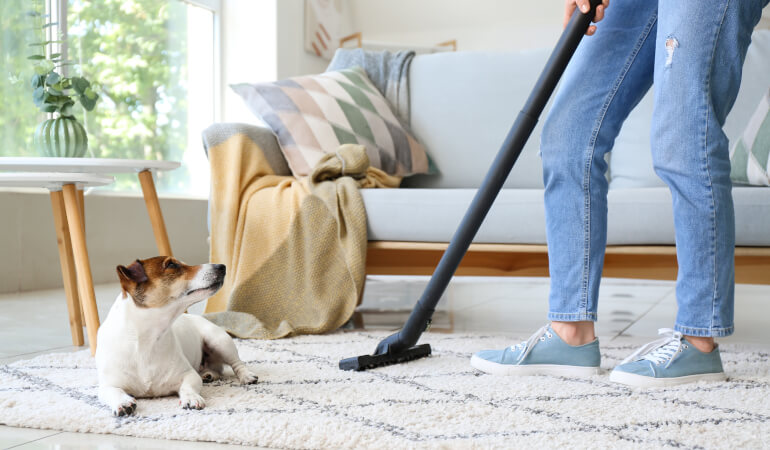
If you’re trying to figure out how to get dog hair out of carpet, you’re not alone. Whether you have a dog, a cat, or both, pet hair in carpet is one of those problems that looks manageable until you actually try to deal with it. The trouble is that carpet fibres trap loose hair and hold it there, and the longer the pile, the harder it is to extract.
 Add to Preferred Sources
That’s why a single method rarely does the full job. The right approach depends on how embedded the hair is, what type of carpet you’re working with, and what tools you have to hand. We’ve compiled eleven tried-and-tested methods, from quick surface fixes to proper deep-clean solutions, so you can work through them in order of effort and stop when the carpet looks the way it should.
TL;DR
- A rubber squeegee or carpet rake with rubber bristles uses static electricity to clump pet hair into easy-to-remove piles.
- Anti-static spray neutralises the charge that bonds hair to carpet fibres — mist lightly, wait 2–3 minutes, then hoover.
- A pet-specific vacuum with a motorised brush head and HEPA filter is the most effective long-term tool for carpeted homes.
- Fabric softener diluted in water, sprayed and left to dry, loosens embedded hair so it hoovers away more easily.
- For heavily soiled carpets, professional hot water extraction removes embedded pet hair, dander, and allergens in a single session.
Table of Contents
1. The lint roller method
There are lint rollers with longer handles which are specially designed for hair removal from carpets. They are generally wider than the regular lint rollers, which are used for removing hair from clothes, however, the idea is pretty much the same.
You just have to thoroughly go over your affected carpets or rugs and the sticky paper will collect dirt, dust and hair. Once the paper gets full of impurities, just peel it off and start working with a clean one. You may have to go over your carpets with the lint roller several times to achieve satisfying results.
2. Rubber squeegee method
The squeegee’s rubber is able to easily extract hair from your carpeting, while also covering large areas at a time.
To rid your carpet of dog hair, just run the squeegee from one end to the other, utilising short and repeated strokes at the highly polluted areas. You will see the hairs clumping together, which will allow you to easily hoover or pick them up by hand.
The reason this works is static charge. Rubber builds up static electricity as it moves across carpet fibres, and that charge actively attracts loose hair, pulling it away from the pile and gathering it into clumps. It’s the same principle that makes a balloon stick to a wall — just put to more practical use.
3. The rubber gloves trick
Rubber gloves are not only effective in protecting your hands from harsh chemicals. Surprisingly, they are also a great tool for cleaning your beloved pet’s hair from the carpet. Grab your new pair of gloves and make sure to use the palm side with the nubs for the hair removal process.
Rubber gloves work by the same static-charge principle as the squeegee: rubber generates static electricity as it contacts carpet fibres, which attracts pet hair and causes it to clump together for easy removal.
To make the dog hair extraction easier, you can moisten the palm side of the gloves with a little bit of water, which will make the hair pile up. Alternatively, you can also try using latex gloves if you don’t have rubber ones available, just know that you may have to change them afterwards, as they aren’t reusable.
4. Balloon method
The balloon trick might look silly at first, however, it can help in removing hair from carpets or rugs. You just need to blow a balloon up and rub it all over the surface of your carpet.
The static electricity generated by rubbing the balloon will lift the hairs from the carpet’s fibres and they will stick to the balloon instead. However, remember that this method may not work as well for larger carpets or rugs and you will have to put in a lot of manual work, as well.
5. Pet hair carpet brush or carpet rake
Carpet rakes are excellent for removing dog hair. They are designed to dig deep into the fabric of a carpet and effectively remove all kinds of impurities. Preferably, get yourself a carpet rake with rubber bristles, as rubber creates static electricity making carpet hair removal a whole lot easier.
To get the most out of your rake, make sure to apply pressure when sweeping the carpet, which will increase the volume of fur you can extract in one try. Also, use short and firm strokes when you’re treating highly affected areas.
And last, but not least, don’t forget to remove the hair from the bristles when it gets stacked, otherwise the rake will get clogged and you won’t be able to pick up as much.
It’s worth knowing that carpet rakes and dedicated pet hair carpet brushes are slightly different tools. Rakes tend to be long-handled with wide-spaced teeth, designed for covering large floor areas efficiently. Pet hair carpet brushes are typically shorter, with denser rubber or bristle heads, and are better suited to targeted patches or smaller rugs. Both work well; the rake suits whole-room coverage, while a compact brush is more practical on stairs or tight spots.
6. Fabric softener
Follow these steps to try removing dog fur from your carpet with a fabric softener. Fabric softener works particularly well as a pre-hoovering treatment because it reduces static cling between hair and carpet fibres, making the hair release more readily when you run the hoover over it afterwards.
- Combine fabric softener with water (1:3 ratio) in a spray bottle.
- Spray the solution over the carpet lightly, ensuring not to soak it.
- Wait for the solution to completely dry.
- The softener should have already loosened dust, dirt and hair from the carpet, so all you have to do now is hoover and you are good to go!
7. Dog or pet hair brush
For those of you who didn’t know, you can also use your furry friend’s brush to rid your carpets of dog fur. Scrape off any excess hair from the carpet by using this pet hair removal tool.
If your brush has long bristles, it will work like a charm on high-pile carpets, as you will be able to reach deeper and remove the stuck hair more easily. Also, a brush with metal bristles will work better, because the stiffness will allow you to drag hair effectively. Again, don’t forget to remove the hair from the brush frequently, or you won’t be able to collect as much.
Use the brush as a pre-vacuum step: loosen and gather the surface hair first, then run the hoover over the area. That order makes both stages more effective than doing either alone.
8. Vacuum cleaner for pets
We all have vacuum cleaners at home, but you might be wondering: “Is a regular vacuum cleaner capable of removing dog hair from carpets and rugs?“. Standard vacuum cleaners without a motorised brush head or pet attachment often struggle to extract embedded hair from carpet fibres. On top of that, a pet’s fur can get tangled around the bristles of your vacuum’s brush, making the whole device harder to manoeuvre and clean effectively.
There are vacuum cleaners specially designed for pet hair removal, and if you’re constantly fighting a losing battle with fur, one of these is worth considering. When choosing a pet vacuum, look for three things in particular: a motorised brush head that actively drives bristles into the carpet pile, a tangle-free turbine that resists hair wrapping around the roller, and a HEPA filter to capture fine dander particles as well as visible hair. These features make a meaningful difference compared with a standard model.
If you aren’t willing to spend a big buck on such a cleaner, an alternative for you will be to purchase a pet hair removal attachment for your regular vacuum cleaner. It won’t be as effective as the specific fur removal cleaner, but it will still do a way better job than your regular vacuum attachment.
9. Shampoo the carpet
You don’t need to regularly shampoo your carpets and rugs, but if it has been some time, this is the right thing to do. Shampooing will deep clean your carpeting, making it not only easier to lift dog hair but also to erase old stains that have been bugging you for a while.
Tools and materials needed for the job:
- Bucket;
- Warm water;
- Carpet shampoo or a mixture of dish soap and water;
- Scrub brush or a stiff-bristled brush;
- Clean towels or rags;
- Vacuum cleaner.
How to shampoo a carpet to remove embedded pet hair and dirt.
Hoover the carpet
Begin by thoroughly hoovering the carpet to remove loose dog hair, dirt and debris. This will make the shampooing process more effective.
Prepare the shampoo solution
In a bucket, mix warm water with a small amount of carpet shampoo. If you don’t have carpet shampoo, you can create a mixture of mild dish soap and water. Avoid using excessive soap to prevent residue buildup.
Test for colourfastness
Before applying the solution to the entire carpet, test a small, inconspicuous area for colourfastness. Apply a small amount of the shampoo solution and blot it with a clean white cloth. If the colour transfers onto the cloth, choose an alternative cleaning method.
Pre-treat stains
If there are specific stains on the carpet, pre-treat them with the shampoo solution. Use the scrub brush to gently agitate the solution into the stain, allowing it to sit for a few minutes.
Shampoo the carpet
Dip the scrub brush into the shampoo solution, then scrub the carpet in small sections. Work in a circular motion, applying even pressure. Continue this process until you’ve covered the entire carpeted area.
Wipe away the residue
After scrubbing, dampen a clean towel or rag with water and wipe away any excess shampoo residue from the carpet. Rinse the towel frequently.
Allow the carpet to dry
Give the carpet time to air dry completely. Open windows or use fans to speed up the drying process. Avoid walking on the carpet until it’s fully dry.
Hoover one last time
Once the carpet is dry, hoover it again to remove any remaining loosened dirt and to fluff up the carpet fibres.
10. Anti-static spray
Anti-static spray is one of the more effective pre-vacuum treatments for embedded pet hair, and one that’s easy to overlook. Pet hair clings to carpet fibres partly because of static electricity: the fibres build up a charge, particularly in dry, centrally heated rooms, and the hair bonds to them as a result. Anti-static spray neutralises that charge, causing the hair to release from the fibres so that a hoover can lift it out properly.
To use it, lightly mist the affected area. Don’t saturate the carpet. Leave it for 2–3 minutes, then hoover as normal. You’ll notice the difference immediately on carpets that previously seemed to hold hair no matter how many times you went over them.
Dedicated anti-static carpet sprays are widely available. If you don’t have one to hand, a diluted fabric softener spray (see method 6 above) serves a similar purpose, since fabric softener also reduces static cling between hair and carpet fibres. The dedicated spray tends to work faster, but either will do the job.
11. Deep cleaning the carpets professionally
If all else fails, or you simply do not wish to deal with this persistent issue yourself, you can always sign up for a professional carpet cleaning session. Expert cleaners have the knowledge, proper equipment and cleaning solutions to deep clean your carpets and rugs, freeing them from long accumulated pet hair, germs and all forms of dirt.
Hot water extraction is a carpet cleaning method that uses hot water and a cleaning solution to deep clean carpets. The process begins with a pre-treatment of the carpet using the cleaning solution. This helps break down and loosen dirt, stains, and pet hair embedded in the carpet fibres.
Hot water, often pressurised, is then applied to the carpet. The heat helps activate the cleaning agents, making them more effective in lifting and suspending dirt and hair.
A powerful vacuum then extracts the hot water along with the dissolved dirt, debris, and pet hair. This process not only cleans the carpet but also removes excess moisture. Afterwards, the carpet is left to dry out completely.
Hot water extraction is particularly effective for households with allergies, as it removes not just visible pet hair but also the microscopic dander particles trapped deep in carpet fibres.
Hot water extraction cleaning benefits when it comes to dog hair removal
- The combination of hot water and cleaning agents helps to break down and lift pet hair, making it easier to extract.
- This method penetrates deep into the carpet fibres, reaching areas where loose hair and dirt may be trapped. It provides a thorough and comprehensive cleaning, reducing the likelihood of residual hair.
- Hot water extraction not only removes visible hair but also helps in eliminating allergens, such as pet dander, from the carpet, promoting a healthier indoor environment.
- This deep carpet cleaning method is suitable for various carpet types and can be adjusted to different levels of intensity, making it adaptable to different degrees of pet hair and soiling.
How do I keep my home free of pet hair?
Keeping your house free of dog hair can be a challenge, but with consistent effort and the right strategies, you can significantly reduce the amount of pet hair in your home. Here are some tips to help you keep your home pet hair-free:
- Brush your dog regularly to remove loose fur. You probably know this, but the more you brush, the less loose hair your dog will shed around the house;
- Opt for furniture with fabrics that are less likely to attract and trap dog hair. Leather or microfiber furniture, for example, is easier to clean than heavily textured upholstery;
- Wash your dog’s bedding, your bedding, and any other linens your dog regularly comes into contact with. This helps reduce the amount of hair in the environment;
- Choose a vacuum cleaner specifically designed to tackle pet hair. We mentioned this before, but again look for hoover models with strong suction power, specialised pet hair attachments, and HEPA filters;
- Keep lint rollers and sticky tape handy to quickly remove hair from clothing, furniture, and other surfaces before it gets a chance to accumulate;
- Sweep, mop, or hoover floors regularly to pick up loose dog hair;
- Install air purifiers with HEPA filters to help reduce airborne pet dander and hair particles;
- Use an anti-static spray or anti-static carpet treatment periodically. This reduces the electrostatic charge that causes pet hair to bond to carpet fibres between cleans, making your regular hoovering sessions considerably more effective.
Frequently Asked Questions
Does anti-static spray damage carpet fibres?
No. Anti-static sprays designed for textiles are safe for most carpet types, including wool and synthetic fibres. Always test on a small, hidden area first, and avoid over-saturating the carpet. Allow the area to dry fully before walking on it.
Can I use a regular vacuum cleaner to remove pet hair from carpet?
A standard vacuum can pick up surface pet hair, but embedded hair often requires a motorised brush head or a dedicated pet hair attachment. If your vacuum has a HEPA filter and a tangle-free turbine, it will perform significantly better than a basic model on carpeted floors.
How often should I vacuum a carpet if I have a dog?
For households with a shedding dog, vacuuming at least two to three times a week is recommended. During seasonal moulting periods, typically spring and autumn, you may need to hoover more frequently. Regular vacuuming prevents hair from working deeper into carpet fibres, where it becomes considerably harder to remove.
Benefit from a professional deep carpet cleaning!
Enter your postcode to view our rates and availability in your area.
For questions about the services we offer visit our main site
Conclusion
The right method for getting dog hair out of carpet depends almost entirely on how embedded the hair is and what type of carpet you’re dealing with. Surface hair responds quickly to a lint roller, rubber gloves, or a squeegee. Hair that’s worked deeper into the pile needs something with more mechanical reach: a carpet rake, a pet hair brush, or anti-static spray followed by a thorough hoover with the right attachment. The static electricity methods (squeegee, rubber gloves, anti-static spray) are particularly worth trying first in dry or centrally heated homes, where static charge is the main reason hair bonds so stubbornly to fibres in the first place.
For persistent shedders or carpets that haven’t had a proper clean in some time, a professional carpet cleaning session is worth the investment. Hot water extraction removes embedded hair, dander, and allergens in a single visit and resets the carpet so that your regular maintenance actually keeps pace with the shedding. Done once or twice a year, it’s considerably less effort than fighting a losing battle with the hoover every week.





Leave a Reply