
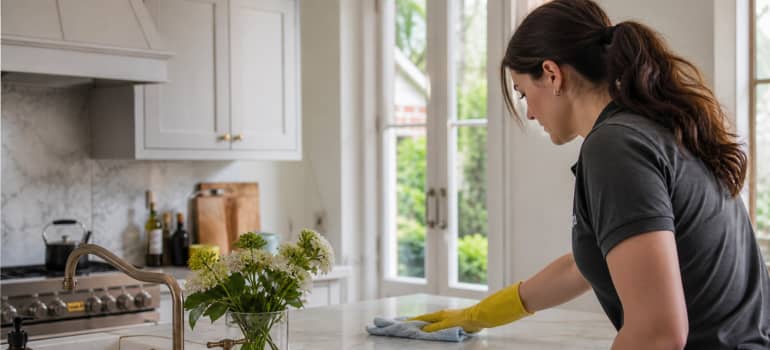
Most people have a rough idea of which parts of their home they’ve been quietly ignoring. The grease on the extractor fan. The limescale around the taps. The gap between the fridge and the wall that’s never been touched. A professional deep house cleaning is designed to deal with exactly those things — the build-up that routine cleaning skips over every single week.
If you’ve never booked one before, it’s not always clear what’s actually included, how long it’ll take, or what you’re supposed to do beforehand. The answers are more practical than you’d think.
TL;DR
- Professional deep house cleaning covers all rooms in detail, including hard-to-reach and often-neglected areas.
- It’s significantly more thorough than a regular clean — tackling things like limescale removal, degreasing, and inside appliances.
- Expect the job to take anywhere from 3 to 8 hours depending on your home’s size and condition.
- Professionals use industrial-grade equipment and products suited to each surface type and room.
- A small amount of preparation beforehand helps the cleaners work faster and focus where it matters most.
- A deep clean doesn’t replace regular cleaning, but it’s a worthwhile reset after building work, illness, or when things have slipped for a while.
Table of Contents
What Does a Deep House Cleaning Include?
A professional deep house cleaning covers every main area of the home in detail, going well beyond what a standard weekly clean addresses. That means dusting, scrubbing, descaling, degreasing, and sanitising surfaces across all rooms — including the spots that rarely get touched during routine maintenance.
Here’s what to expect, room by room:
- Living spaces — Thorough dusting of all surfaces, skirting boards, light fittings, and shelves. Vacuuming furniture, cushions, and carpets, followed by mopping hard floors. Window ledges and frames get attention too.
- Bathrooms — Descaling taps, showerheads, and tiles. Sanitising the toilet, basin, and bath. Cleaning grout lines, mirrors, and the soap scum that’s been building up on the shower screen for longer than you’d like to admit.
- Kitchen — Degreasing the hob, extractor fan, and splashback. Cleaning inside and outside appliances including the microwave, oven exterior, and fridge. Wiping down cabinet fronts, worktops, and the sink — including the area around the taps where limescale accumulates quietly.
- Bedrooms — Dusting all surfaces including the tops of wardrobes and bed frames. Vacuuming under and around furniture. Cleaning mirrors and built-in storage surfaces. Changing bed linens where requested.
- Hallways and stairs — Vacuuming or mopping floors, dusting banisters and light fittings, wiping down skirting boards and doors.
The key difference is depth. A regular clean keeps things looking presentable. A deep clean addresses what’s actually there — the grease on the extractor fan, the mildew on the shower seal, the dust on top of the wardrobe you’d need a ladder to reach. Same rooms. Treated properly.
Why Is Professional Deep Cleaning Worth It?
There’s an obvious visual payoff to a professional deep clean, but the benefits go further than things just looking better. A properly cleaned home is measurably healthier, and that’s not an exaggeration.
- Improved air quality — Dust, mould spores, and pet dander settle into surfaces and soft furnishings over time. A deep clean removes the bulk of it, which makes a real difference if anyone in the house has asthma or allergies.
- Allergen reduction — Dust mites thrive in carpets, mattresses, and upholstery. Thorough vacuuming with high-filtration equipment significantly reduces their numbers in a way a standard hoover doesn’t.
- Stubborn build-up, properly dealt with — Hard water limescale, baked-on oven grease, and mould in grout are not going to shift with a general cleaner and five minutes of effort. Professionals know which products work on each type of dirt and how to use them safely.
- Time saved — A job that would realistically take a homeowner a full weekend takes a professional team a fraction of that. That’s not just about speed. It’s about knowing the right sequence, the right products, and not stopping to work out what to do next.
- A genuine reset — After building work, illness, moving in, or simply letting things slide for longer than you’d like to admit, a deep clean gives you a clean slate to maintain from.
There’s a less talked-about benefit too: it makes regular cleaning easier afterwards. When grime hasn’t been compounding for years, the weekly wipe-down actually does what it’s supposed to.
How Long Does a Deep House Cleaning Take?
For an average UK home, a professional deep house cleaning typically takes between 4 and 8 hours. A small flat might be done in 3 hours with a two-person team. A larger detached house in poor condition could take a full day. The honest answer is: it depends on your property.
The three main factors are size, number of rooms, and how long since the last proper clean. A flat that gets a regular tidy is a very different job to a four-bedroom house that’s been lived in hard for two years.
Here’s a rough guide based on common UK property types:
- Studio or one-bed flat — Typically 3 to 4 hours with a single cleaner, faster with a team of two.
- Two-bedroom house or flat — Roughly 4 to 6 hours depending on condition.
- Three-bedroom house — Expect 5 to 7 hours, more if the kitchen or bathrooms need significant work.
- Four-bedroom or larger property — Often a full day, sometimes split across two visits for particularly large homes.
If your home is cluttered or hasn’t had a proper clean in a long time, factor in extra time. Cleaners can’t work efficiently around piles of belongings, and they’ll need longer on surfaces that have had years of build-up. The cleaner the starting point, the faster the job goes.
How Do You Prepare Your Home for a Deep Clean?
A professional team works faster and more thoroughly when they can actually get to what needs cleaning. A bit of preparation before they arrive makes a genuine difference to what they’re able to cover. It’s not about doing their job for them. It’s about making sure nothing gets in the way.
- Declutter the main rooms. Surfaces covered in paperwork, clothes piled on chairs, toys across the floor — all of it slows the cleaners down. They end up moving your belongings instead of cleaning underneath them. Clear the obvious clutter beforehand and the results will be noticeably better.
- Secure valuables and fragile items. It’s not about distrust. A cleaner working quickly through a room shouldn’t have to navigate around irreplaceable ornaments. Move anything fragile or valuable to a safe spot before the team arrives.
- Write down your problem areas. That stain on the carpet. The limescale on the shower screen you’ve stopped seeing. The inside of the oven. Hand the list to the team when they arrive. They can’t prioritise what they don’t know about, and most services are happy to focus extra attention where it’s needed.
- Arrange for pets and children to be elsewhere. Some cleaning products — even eco-friendly ones — have strong odours during application. Pets are particularly sensitive to these. Having small children underfoot when people are carrying equipment is also a hazard worth avoiding. If possible, arrange for them to be out for the duration.
- Make sure every area is accessible. If rooms are usually locked, or appliances need to be emptied first, sort that before the team arrives. An oven can’t be cleaned properly if it’s full of trays. A fridge needs to be cleared before anyone can get inside it.
Five minutes of preparation saves the cleaners time and means you get better results. It really is that simple.
What’s the Difference Between Deep Cleaning and Regular Cleaning?
A deep clean is not just a regular clean done more thoroughly. The two services have different scopes, different frequencies, and a different standard altogether. Understanding the distinction helps you decide which one you actually need.
| Regular Cleaning | Deep Cleaning | |
|---|---|---|
| Frequency | Weekly or fortnightly | Every 3 to 6 months, or as needed |
| Focus areas | Visible surfaces, floors, and general tidying | All surfaces including behind, underneath, and inside |
| Kitchen | Wipe down worktops and hob | Degrease hob, clean inside oven and appliances, descale sink |
| Bathroom | Clean toilet, sink, and bath surface | Descale, sanitise grout, clean sealant, remove mould |
| Dusting | Accessible surfaces | Light fittings, tops of doors, skirting boards, behind furniture |
| Time required | 1 to 3 hours | 3 to 8 hours or more |
| Best suited for | Maintaining cleanliness | Resetting after illness, building work, or a long gap |
Regular cleaning maintains a home. A deep clean restores it. If you’ve kept up with weekly cleaning, your deep clean will be faster and the results will be more noticeable. If you haven’t, the deep clean does the heavy lifting that routine cleaning was never going to reach.
Maintenance and overhaul. Both have a place. They’re just not the same job.
What Tools and Techniques Do Professionals Actually Use?
The results from a professional deep clean aren’t just about effort. They come from using the right tools for the right surfaces and knowing which products actually work on each type of dirt. Grease doesn’t respond to the same thing as limescale. Mould needs a different approach to soap scum. Professionals understand that and work accordingly.
- Appropriate cleaning products for each surface — Professional cleaning uses products formulated to break down specific types of soiling. Alkaline degreasers cut through kitchen grease and oil. Acidic descalers dissolve mineral deposits in bathrooms and around taps. Neither works well on what the other is designed for, which is exactly why using a single all-purpose product rarely gets good results. Products used by professional services are also COSHH-compliant, meaning they’re assessed for safe use in domestic environments.
- Industrial-grade equipment — HEPA-filter vacuum cleaners capture particles as small as 0.3 microns, which includes most common allergens. A standard household hoover doesn’t come close to that standard. Steam cleaning machines and high-pressure tools remove what domestic equipment simply can’t reach or shift.
- A consistent working method — Professional teams clean top to bottom and dry to wet. That means dust and debris fall downward onto surfaces that haven’t been cleaned yet, not onto ones that have. It sounds obvious, but it makes a real difference to the end result — and it’s something most people don’t apply when cleaning their own homes.
If you keep up with routine home maintenance but want the whole property properly reset, a one-off cleaning service goes through everything systematically — covering the areas that regular cleaning rarely touches and leaving things in a state that’s genuinely easier to maintain.
Is your home ready for a professional deep clean?
Enter your postcode to view our rates and availability in your area.
For questions about the services we offer visit our main site
Conclusion
A professional deep house cleaning isn’t a luxury. For homes dealing with build-up that routine cleaning can’t shift, it’s the most practical option available. It takes the right tools, the right chemistry, and the kind of systematic approach that gets into every corner rather than just making the visible surfaces look acceptable.
Do it properly once, and regular maintenance becomes significantly easier. You won’t be starting from scratch every time.







Leave a Reply