
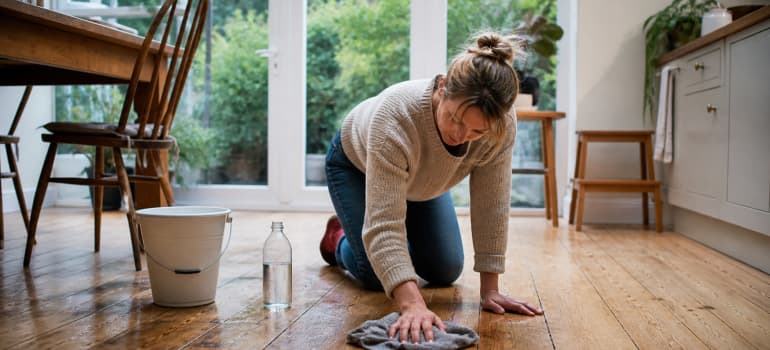
There’s a lot of well-meaning but genuinely harmful advice floating around about how to clean wooden floors naturally. The most common offender? Vinegar. It’s held up as a miracle solution, the kind of thing passed down from a parent or found in a “5 natural cleaning hacks” article that’s been copied and reshared so many times nobody knows where it started. The problem is, it can silently damage your floor’s finish over time, and by the time you notice, the harm’s already done.
Natural cleaning doesn’t have to mean risky cleaning. There are genuinely effective, floor-safe approaches that don’t involve harsh chemicals. But getting there means cutting through the myths first. This post covers what actually works, what you should leave on the shelf, and a few lesser-known tricks that most guides never mention.
TL;DR
- Avoid vinegar, it can dull or damage your floor’s finish over time.
- Use a pH-neutral, plant-based cleaner instead of DIY acid-based solutions.
- Mop with minimal moisture; a damp microfibre mop is enough.
- Dry the floor immediately after mopping to prevent water from sitting in the grain.
- Your floor’s finish type determines which natural cleaners and treatments are safe to use.
Table of Contents
How to Safely Clean Wooden Floors Naturally
The core principle of cleaning wooden floors naturally is simple: use as little liquid as possible and choose ingredients that won’t undermine your finish. Wood and water are not friends. Even finished floors are vulnerable to moisture getting into the joins, the edges, the grain. Over time, that causes swelling, warping, and a kind of dullness that no amount of polishing will fix.
A safe natural clean works in a sequence: clear the debris first, apply a minimal amount of pH-neutral solution, mop without soaking, dry immediately. Each step matters. Skipping the drying stage is one of the most common mistakes, and it’s also one of the most avoidable. Here’s the full process laid out properly.
How to clean wooden floors naturally using minimal moisture and safe, pH-neutral ingredients.
Clear the floor of loose debris
Before any liquid touches the floor, go over the entire surface with a soft-bristle broom or a dry microfibre mop. You’re looking to pick up dust, grit, hair, and any loose particles that could scratch the surface when you start mopping. Don’t rush this stage. A piece of grit dragged under a wet mop leaves a mark. Work from the far end of the room towards the door so you’re not walking back over what you’ve swept.
Mix a natural cleaning solution
Make your natural cleaning solution. Fill a bucket or spray bottle with warm water and add a small amount of pH-neutral, plant-based soap, just a few drops. You’re not making a soapy bucket here; you want the solution to be almost clear. Some people add a few drops of a mild essential oil for fragrance, which is fine in very small quantities, but skip anything citrus-based. The goal is a gentle surfactant that lifts surface dirt without altering the floor’s pH.
Mop with a barely damp microfibre mop
Wring the mop out thoroughly before it touches the floor. It should feel almost dry to the touch, not wet. Work in sections, following the direction of the wood grain, and avoid going over the same spot repeatedly. Microfibre is ideal here because it traps dirt rather than just pushing it around, and it doesn’t require nearly as much water as a traditional string mop. If you’re using a spray mop, one or two light spritzes per section is enough.
Dry the floor immediately
Follow the mop with a clean, dry microfibre cloth or a dry mop head. Don’t leave the floor to air dry. Even a small amount of residual moisture sitting in the grain or along the edges of boards can cause problems over time. Work quickly, in the same direction as the wood grain. This step is short but it’s not optional. Treat it as part of the clean, not an afterthought.
Are Natural Cleaners Effective for Wooden Floors?
Yes, natural cleaners can be effective for wooden floors, but only when you choose the right ones. The mistake most people make is assuming “natural” automatically means safe. Some of the most damaging things you can put on a wood floor are entirely natural. Effectiveness comes down to pH, moisture content, and whether the ingredient actually suits your floor’s finish, not whether it came from a plant.
Natural cleaners fall into a few broad categories when it comes to wooden floors. Some are genuinely suitable: pH-neutral plant-based soaps diluted in water, for example, clean the surface without attacking the sealant. Others, like citrus-based solutions or anything acidic, can gradually strip the protective layer that keeps your floor looking like a floor and not a scratched-up plank.
The finish type matters too. An oiled floor behaves very differently to a polyurethane-sealed floor. What works on one can wreak havoc on the other. So before anything else, know what you’re working with. If in doubt, your flooring installer or manufacturer’s guidance is the most reliable starting point.
Which Finish Does Your Wooden Floor Have?
The single most important factor in cleaning wooden floors naturally is knowing what finish you’re working with. Different finishes react differently to moisture, pH, and natural additives. Using the wrong approach on the wrong finish is exactly how floors end up dull, sticky, or warped.
| Finish Type | Description | Natural Cleaning Notes |
|---|---|---|
| Polyurethane sealed | Hard, plastic-like surface coating that sits on top of the wood | pH-neutral cleaner only. No vinegar, no oil treatments. Most common in modern homes. |
| Oiled | Oil penetrates and nourishes the wood fibres rather than coating the surface | pH-neutral cleaner. Occasional natural oil treatments (linseed, jojoba) are appropriate. More maintenance-intensive. |
| Lacquered | Thin, hard surface coat, similar to polyurethane but typically less durable | pH-neutral cleaner only. Avoid anything acidic or abrasive. Very low moisture tolerance. |
| Waxed | Natural wax coating that sits in and on the surface wood layer | Damp clean only, no soaps. Beeswax re-treatment suits this finish well. Water sitting on waxed floors causes white marks. |
If you bought the property with the floors already installed and have no documentation, the simplest test is this: drop a small amount of water on the surface in an inconspicuous spot. If it beads up and sits on the surface, the floor is sealed. If it starts to absorb within a minute or two, it’s likely oiled or waxed. This matters before you choose any cleaning method.
Natural Additives for Maintaining Wood Floor Finish
Beyond the standard clean, there are a handful of natural options that can quietly do a lot for the look and condition of a wooden floor over time. These aren’t cleaning agents exactly. They’re more like maintenance tools, things you use occasionally to keep the floor looking its best between deeper cleans.
Most guides skip over these entirely, which is a shame because they’re genuinely useful.
- Cooled black tea rinse. Brewed black tea contains tannins that can gently enhance the natural tone and grain of wood when used sparingly as a final rinse. Apply it with a barely damp cloth, follow the grain, and dry immediately. It won’t strip or damage sealed floors, and it leaves a subtle warmth that plain water doesn’t. Use it occasionally, not every clean.
- Linseed or jojoba oil (for oiled floors only). A very small amount of food-grade linseed oil or jojoba oil, buffed in with a soft cloth, can restore the nourished look to an oiled wood floor that’s starting to look dry and flat. This only works on floors with an oil finish. On sealed (polyurethane or lacquered) floors, oil will sit on the surface, attract dirt, and make things worse.
- Beeswax polish. Traditional beeswax is one of the oldest natural wood floor treatments there is, and it still works. It buffs to a low-sheen finish, adds a layer of protection, and smells considerably better than synthetic alternatives. Use it sparingly and buff thoroughly. Too much left on the surface will make the floor sticky and attract more grime than it repels.
- Walnut rub for minor scratches. A shelled walnut, rubbed gently over a light surface scratch, releases natural oils that temporarily blend the scratch into the surrounding wood tone. It’s not a repair. The effect fades over time, but it works remarkably well as a quick fix while you decide on a longer-term solution.
- Cooled chamomile tea (for lighter woods). Similar in principle to black tea but milder, chamomile tea can be used as a gentle rinse on very light or blonde wood floors to brighten the grain without darkening it. Apply with a nearly dry cloth, follow the grain direction, and dry straight away.
None of these are magic fixes, and none of them replace a proper clean. But used at the right moments, they extend how good the floor looks between bigger maintenance jobs without introducing anything harsh into the mix.
Common Myths About Cleaning Wooden Floors Naturally
The natural cleaning space is full of advice that sounds credible, gets repeated enough to feel authoritative, then quietly damages thousands of floors. It’s worth being direct about what’s actually a myth and why it persists.
Myth 1: Vinegar is safe for all wood floors. This is the big one. White vinegar is acidic, sitting at a pH of around 2.5–3. That acidity is what makes it effective on limescale and certain stains. It’s also what makes it damaging to wood floor finishes, particularly polyurethane. It doesn’t ruin a floor in one go. It degrades the finish gradually, leaving it dull and more vulnerable to moisture. The reason this myth persists is that short-term, the floor looks clean. The damage accumulates quietly over months.
Myth 2: More soap means a cleaner floor. Too much soap, even a gentle, plant-based one, leaves a residue. That residue builds up with each clean, making the floor look streaky and dull. It also acts as a magnet for dust and grit. A few drops of soap in a full bucket of water is genuinely enough.
Myth 3: Steam cleaning is a natural, chemical-free option for wood. Steam is water vapour at high temperature. That heat and moisture combination drives moisture directly into the wood surface, past the finish, and into the grain. Over time it causes swelling, warping, and can loosen the adhesive on engineered floors. It’s not a natural cleaning method in any sense that benefits wood. Avoid it.
Myth 4: Any plant-based cleaner is automatically pH-neutral. Plant-based doesn’t equal neutral. Citrus-based cleaners are derived from plants and are still acidic. Castile soap, depending on concentration, can sit on the alkaline side. When choosing a natural cleaner for wooden floors, the pH label matters more than the “natural” label. Aim for something around pH 7, and check the product information rather than relying on assumptions.
Understanding pH isn’t complicated. It’s a scale from 0 (very acidic) to 14 (very alkaline), with 7 being neutral. Wood finishes are happiest when exposed to cleaners sitting close to that middle point. Anything straying too far in either direction can cause problems over time, natural ingredient or not.
If you use a domestic cleaning service periodically, it’s worth mentioning your floor type and finish upfront. A good service will adapt their products and methods accordingly rather than reaching for a one-size-fits-all approach.
Want your floors professionally cleaned?
Enter your postcode to view our rates and availability in your area.
For questions about the services we offer visit our main site
Frequently Asked Questions
Can essential oils be used on wooden floors?
Essential oils can be added to a cleaning solution in very small quantities, mainly for fragrance. The key word is small: a couple of drops in a full bucket of water. Avoid citrus oils like lemon or orange, which are acidic enough to affect some finishes. Tea tree oil is often cited as a natural antibacterial option, but it should also be heavily diluted. When in doubt, leave them out and stick to a plain pH-neutral cleaner.
How do I deal with scratches on wooden floors?
For light surface scratches, try rubbing a shelled walnut over the mark. The natural oils blend it into the surrounding wood tone temporarily. A cooled tea bag applied to the scratch can also darken light marks on medium-toned floors. Neither is a permanent fix. For deeper scratches that catch your fingernail, professional refinishing is the only reliable solution. Attempting to sand a small section yourself rarely ends well unless you know exactly what you’re doing.
What are pH-neutral cleaning agents?
pH-neutral cleaners sit at or very close to pH 7, which is the neutral midpoint of the pH scale. At this level, the cleaner is gentle enough to lift surface dirt without reacting chemically with your floor’s finish. Many plant-based soaps marketed for wood floors are formulated to be pH-neutral, but always check the label. ‘Natural’ and ‘pH-neutral’ are not the same thing. If the label doesn’t specify pH, that’s worth noting before you use it on a finished floor.
Why shouldn’t steam cleaners be used on wood?
Steam cleaners force hot water vapour into the floor surface at pressure. Even with a protective finish in place, that moisture finds its way into the wood grain over repeated use, causing swelling, warping, and in the case of engineered boards, potential delamination. The heat can also soften certain adhesives used in engineered flooring. It might look harmless in the short term, but the cumulative damage from regular steam cleaning on wood is well documented by flooring professionals.
Conclusion
Knowing how to clean wooden floors naturally is mostly about knowing what not to do. Vinegar, too much soap, steam, excessive water: these are the things that cause the quiet, cumulative damage that shows up months later as a dull, worn finish. The right approach is boring in the best way. A pH-neutral cleaner, a barely damp mop, and a dry cloth straight after.
The natural maintenance options covered here, the black tea rinse, beeswax, oiling where appropriate, are worth experimenting with once you’ve got the basics right. Keep the moisture low, check your finish type before you try anything new, and your floors will hold up far longer than the vinegar crowd’s will.





Leave a Reply